My first job after IIT was at L&T General Workshops, on the other side of Powai Lake! I found it to be a frustrating place to work in for a fresh graduate engineer trainee, because all they did was let you loose in the shops. I got great on-the-job shop floor training, but little mentorship. I guess it was the culture of L&T at that time with each one looking out for themselves.
Then in June of 1975, Emergency was declared and soon the union rivalry between the AITUC and Shiv Sena turned violent. I recall outside goondas infiltrating the shops and using iron rods to assault rival union members. The tension was something else! L&T company buses from Andheri and other train stations to Powai were stopped by goondas throwing stones and bricks. As a result, Management declared a lockout of all Powai operations. As supervisory staff, we were asked to sign in every day at company headquarters in Ballard Pier. We signed in and were off the whole day.
That’s when a couple of guys and I started a design and engineering consulting business. We would go to L&T suppliers and others and received jobs that we’d execute. We’d create designs and deliver drawings for which we got paid a couple of thousand bucks. That was my first foray into entrepreneurship.
By 1978, I had saved some money and quit L&T to join IIMA. After graduating in 1980, I started a consulting business in Bombay with Ashok Desai (EE ’74) as a partner. Ashok’s father-in-law had an apartment in Bombay Central that we used as an office. Somehow, consulting gigs moved from engineering consulting to Information Technology. PCs had come into the Indian marketplace and demand for programming and systems was very strong.
The first couple of years as an entrepreneur were filled with hard work but were very rewarding. Then, just as things were settling down, Maria walked into my life. Cupid really hit hard, and although I was quite happy in Bombay, we married and I came to the US in late 1982.
The US at that time was in a terrible recession. Alan Greenspan was putting the squeeze on the economy to control inflation and I landed here in the middle of that. Couldn’t find a decent job for almost a year. I was just about ready to go flip burgers or go home! Finally, an IIT Kharagpur guy who was in IT at one of the local refineries, referred me to his IIT buddy who worked at Control Data Corporation (CDC), who got me an interview which resulted in a job offer!
The division of CDC I worked for built custom applications delivered via timesharing. I was very motivated but 6 months later the layoffs started. CDC, like Wang, Prime, DEC, and other great companies with great people, was caught in the shift in technology from mainframes to PCs. My fear of being the most junior, and therefore the first to go, was unreal!
As it turned out, I was the assigned rep to some important accounts. I was the insurance policy to keep those customers happy. Several layoffs later, we were just two guys who comprised the Philadelphia office. I got moved to an EDI Division of CDC which got sold to Sterling Software. By then I had figured out the corporate game, realizing they were keeping me on for insurance. I played along while building a base of connections. When the squeeze came for me to move to Ohio, I decided to quit and, with support from my wife, started my consulting business building custom client/server applications. It was the 90’s and business was booming. I didn’t quite understand how business in the US was done, but I was able to execute pretty well and kept growing. As we approached 2000, technology changed. Applications changed from windows based to browser based but the backend was still a database. Then the World Trade Center and Pentagon were hit on 9/11.
That really decimated the IT scene in the US. The country shut down. All corporate discretionary spending stopped. A lot of our business simply disappeared. It was like a forest fire that took out small and mid-sized IT shops. We had around 10 people and I cut back to three – two programmers and myself. It was very tough but needed to be done to survive.
The programmers were a young girl and a 27-year-old guy, both from India. Two weeks later, the guy literally walked into a wall at the office, because he could not see for a moment! I told him to go home and see a doctor which he did the next day. Turned out the poor fellow had advanced leukemia with a tumor in his brain putting pressure on his eye. I visited him in the hospital 2 days later but within 24 hours he was gone!
It was devastating. I had gone through the process of laying off folks and now this. I begged some of my customers for work which they did give me, but all this was too much for the young girl who quit!
At this point, I was like a zombie, mechanically going to work, sitting there for four hours, leaving for lunch, coming back, sitting there, and then going home. A couple of good friends helped me work through it, and I slowly built the company back. By the time the financial crisis hit in 2007-08, I was a veteran and was able to deal with any calamity!
Why do I continue to work? Because once the entrepreneurial bug bites, you’re hooked! You enjoy working as well as the ups and downs of business. From being a slave to your boss and management, you become a slave to your customer, but it’s okay! It’s energizing! Everything we built was custom, new, and interesting. As one of our customers said, “You know, we don’t really know what you’re doing. But just keep doing it because it’s working great!”
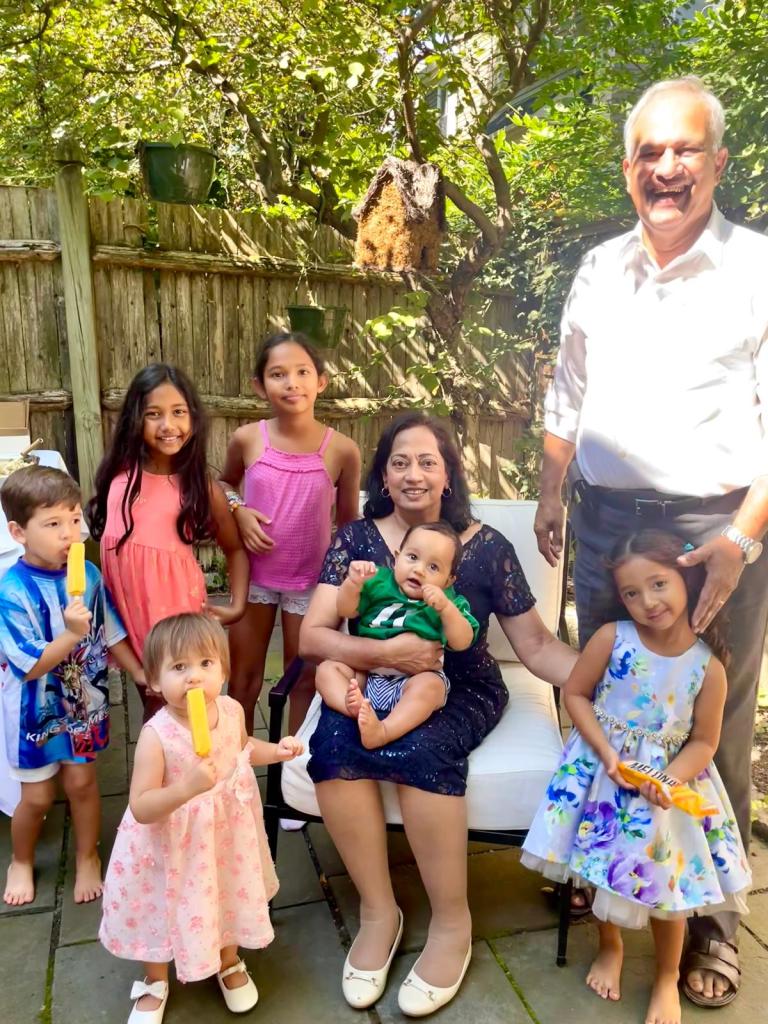
My business was all Microsoft based, and Microsoft started working with larger business partners, “encouraging” smaller shops to merge with larger ones. I decided to hold out and maintain my independence. I have shrunk my business and operate out of my house now and have plenty of time to visit grandkids!
Q: How did you go from being an engineer into a businessperson?
Well, I would say that transition happened primarily in Bombay. After my MBA I got an assignment with a company that made electroplating plant and equipment. I was introduced to them by a Mr. Daver who trained Vijay Rajadhyaksha and Ashok Desai at Batliboi. I started applying everything I learned on the L&T shopfloor plus all the MBA stuff. I slowly removed the blocks to information flows, and within 3 months output doubled. 3 months later, it doubled again.
I didn’t want to stay on as a production manager, so I introduced Pruthvish Dave (EE ’74) who was looking for a job at that time. Dave stayed there for a couple of years as Production Manager. And that’s how I got into entrepreneurship. The combination of engineering knowledge with MBA skills, particularly understanding business process, helped me throughout the journey. But I could not have done it without the IIT connections, for which I am most grateful!
 IIT Bombay 1974 Reunion