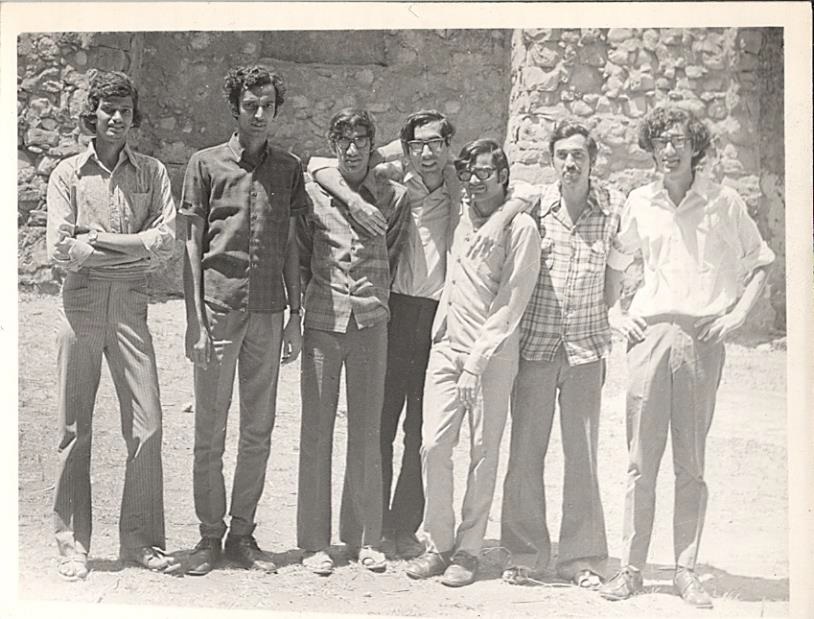
It was a hot Bombay day. I was about 16 and my father patiently explained: Look, engineering is not for you. Take up medical school. My brother challenged me: Can you draw a straight line? If you can’t, engineering is not for you. I couldn’t draw. Their arguments completely convinced me. The next day I enrolled in the Agarwal classes for the entrance exam to IIT. Sometime in June 1969 I enrolled in the Chemical Engineering program at IIT Bombay, hardly knowing that a rollicking, nerve-wracking five years lay ahead. It was a lot of fun (well, maybe not Workshop), as I spent more time playing bridge than studying, directing plays, went off to debate and quiz tournaments, with Nandkumar Mugve helped Ramesh Advani organize the first Mood Indigo festival, campaigned for General Secretary and, thankfully for the student community, lost.
I applied to various programs in the United States, mainly because (like writing the IIT entrance exam) it’s what everyone else was doing. I was actually admitted to the master’s program in Chemical Engineering at Minnesota (a top Chem E department then and now) and decided instead to accept an offer at Union Carbide at their ethylene cracking refinery in Trombay. One unfortunate day (after I almost burned down the plant) I decided it was time to move on. Nandkumar Mugve was an MBA student at the Graduate School of Industrial Administration at Carnegie-Mellon University in Pittsburgh, so I applied to their MBA program.
After I received the admission letter, I had a brilliant idea. I was going to enroll in their Ph D program in Industrial Administration and then use my knowledge (ha!) of Chemical Engineering to become a big shot consultant. I wrote asking to be considered for admission to the Ph D program in Industrial Administration, based on my MBA application. They replied: “Congratulations, you have been admitted to the Ph D program in Economics”. What Economics I said. I had never thought of that. You can guess the rest. I accepted the offer and showed up in Pittsburgh in the fall of 1974.
Lady Luck has always been on my side. I showed up at Carnegie just as a bunch of hardy pioneers, Bob Lucas and Ed Prescott, were reshaping macroeconomics, grounding it more firmly in theory. They were largely treated with disdain by the powers-that-be in the East and West coasts, but the revolution they began is now the way the profession addresses a wide variety of issues and they both went on to win Nobel Prizes. I did well in the program largely because something of my training at IIT must have rubbed off. Both engineering and economics value rigorous analysis and both use mathematics to make sure that the analysis is correct.
Lady Luck continued to be at my side. I accepted an offer as Assistant Professor at the Kellogg School of Management at Northwestern University. The other major revolution at the time was in Game Theory, and Kellogg was at the center of that revolution. Again, the pioneers, Roger Myerson, Paul Milgrom and Bengt Holmstrom, were treated with disdain by the powers that be, and they all went on to win Nobel Prizes. I learned enough game theory at Kellogg and enough dynamic macroeconomics at Carnegie that I was able to write several papers integrating game theory into macroeconomics. People seemed to like my papers, so that worked out well.
In terms of my professional life, I am proudest of having supervised about 100 Ph D students, all of whom enriched my life and many of whom went on to successful careers. My students are tenured professors at the University of Chicago, Yale, Penn, Wisconsin, Carnegie and other leading institutions. One of them makes monetary policy for Switzerland! I have been the luckiest in my personal life. I met Mythili (Mike) in 1983, and we were married shortly thereafter. She is the rock without whom I would be lost. We have two daughters Divya, a surgeon, married to Santosh Iyer, a robotics engineer, and Deepa, a lawyer. Divya and Santosh have two children Avni Riya Iyer (4 years old), and Vivek Krishna Iyer (1 Year old), the delight of my life. This extraordinary family is what convinces me that I am the luckiest man alive.
 IIT Bombay 1974 Reunion